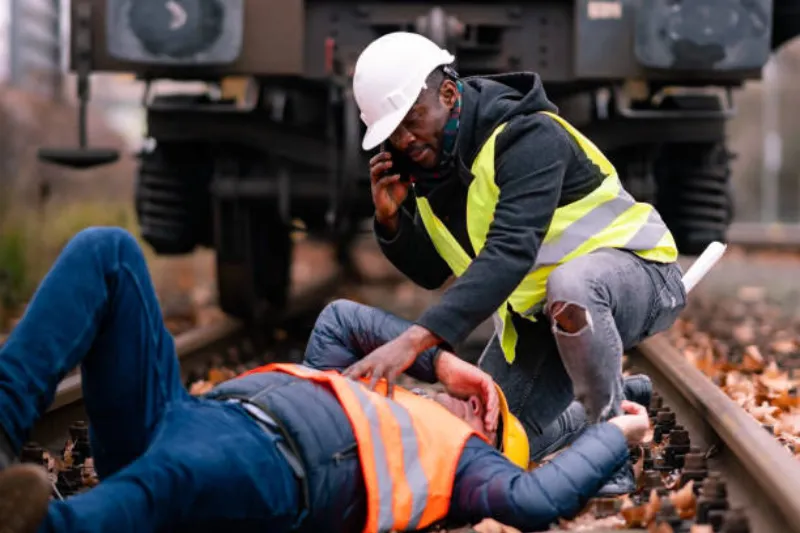
If you were hurt while working for a railroad, the claim may not follow the same path as a regular state workers' compensation case. Many railroad employee injury claims are handled under FELA, a federal law that lets injured railroad workers seek compensation when railroad negligence played a part in the injury.
That can sound simple until the railroad, claim department, medical reports, witness statements, equipment records, and deadline questions all start moving at once. A FELA lawyer can help you sort out what happened, what evidence matters, and whether the railroad's conduct, equipment, track, worksite, or safety practices contributed to the injury.
LTHZ Law's page for injured railroad workers explains the broader issues involved in a railroad injury attorney claim, including collisions, derailments, unsafe working conditions, equipment failure, toxic exposure, repetitive stress injuries, and damages.
FELA stands for the Federal Employers' Liability Act. The federal statute applies to common carriers by railroad engaged in interstate or foreign commerce and allows injured railroad employees to bring claims when injury or death results, at least in part, from railroad negligence. The official text appears in Title 45, Chapter 2 of the U.S. Code.
In plain terms, FELA is not automatic benefit paperwork. The worker generally has to show that the railroad's negligence contributed to the injury. That may involve unsafe equipment, poor maintenance, defective track, inadequate training, unsafe procedures, unreasonable work demands, or another condition the railroad should have addressed.
Workers' compensation usually does not require an injured employee to prove that the employer was negligent. FELA is different. It is a fault-based claim, which means the facts around safety, maintenance, supervision, training, and working conditions can matter a great deal.
That is why railroad employees should be careful about assuming their claim works like ordinary California workers' compensation. Some benefits and medical issues may look familiar, but the legal route, evidence, damages, and negotiation posture can be very different.
It is worth getting legal guidance early if the injury happened around a derailment, collision, yard accident, unsafe walkway, defective tool, equipment failure, bad signal, chemical exposure, repetitive trauma, or pressure to give a recorded statement before you understand your rights.
A lawyer can look at what needs to be preserved while the details are still fresh. That may include photos, names of witnesses, incident reports, maintenance records, safety rules, inspection history, medical records, and communications from the railroad or its claim representative.
Negligence depends on the facts. In a FELA case, the question is often whether the railroad failed to use reasonable care to keep the workplace, tools, equipment, track, roadbed, or operating practices safe.
Examples can include poor maintenance, missing safety equipment, unsafe ballast or walkways, defective brakes or couplers, inadequate staffing, rushed work, failure to enforce safety rules, poor training, or ignoring known hazards. The point is not just that an accident happened. The point is whether something the railroad did, or failed to do, helped cause it.
Get medical care first, especially if there is head trauma, loss of consciousness, severe pain, electrical injury, chemical exposure, or trouble breathing. Serious injuries such as a head or brain injury should be documented clearly from the start.
Report the injury, keep copies of paperwork, write down what happened while you still remember it, and save names of people who saw the condition or the incident. If photos can be taken safely, they may help later. Avoid signing a broad release or giving a recorded statement if you are not sure what it means.
A FELA claim may involve medical expenses, lost wages, reduced earning capacity, pain and suffering, disability, and the way the injury changes daily life. The available damages depend on the injury, medical evidence, work history, and proof of negligence.
In the most serious cases, a railroad injury can be fatal. Families may need guidance about a work-related death claim, especially when the cause of the accident, safety history, and responsible parties are disputed.
FELA has its own rule for shared fault. Under the federal statute, contributory negligence does not automatically bar recovery, but damages can be reduced in proportion to the worker's share of fault. That language is also in Title 45, Chapter 2.
So if the railroad argues that you caused the accident, that does not necessarily end the case. It does mean the details matter: what training you received, what instructions were given, whether the equipment was safe, whether the work area was maintained, and whether the railroad had already been warned about the danger.
FELA generally gives injured railroad workers three years from when the claim accrues to file suit. The deadline can become complicated in gradual injury, exposure, or repetitive trauma cases, so it is safer to ask early instead of waiting until the date is close. The limitation appears in 45 U.S.C. Section 56.
Even when the deadline is not immediate, evidence can disappear quickly. Equipment gets repaired, work areas change, witnesses move on, and records may be harder to obtain later.
If you were injured while working for a railroad, Leep Tescher Helfman and Zanze can help you understand whether FELA may apply, what facts need to be reviewed, and what questions should be asked before you accept the railroad's version of what happened.
The first conversation should focus on the practical facts: what happened, what hurt, what the railroad documented, what medical care you received, and whether unsafe conditions, equipment, training, or supervision may have contributed to the injury.
No. Workers' compensation is usually a no-fault benefit system. FELA is a federal negligence-based law for many injured railroad employees, so the worker generally needs to show that railroad negligence played some part in the injury.
FELA generally applies to employees of common carriers by railroad engaged in interstate or foreign commerce. Contractors, rail-adjacent workers, and non-railroad employees may need a different legal analysis.
Not necessarily. FELA claims can involve shared fault. If the worker is found partly responsible, damages may be reduced, but the claim is not automatically defeated only because the railroad argues the worker also made a mistake.
FELA cases can involve sudden accidents, derailments, collisions, falls, electrical injuries, equipment failures, toxic exposure, repetitive trauma, and other injuries tied to railroad work and railroad negligence.
Be careful. A statement can affect how the railroad evaluates the claim. If you are unsure what is being asked or whether the statement is complete, it may be wise to speak with a lawyer first.